Blog

Displaying 6 to 10 of 30 blog entries

« Previous | 1 | 2 | 3 | 4 | 5 | 6 | Next »
20/11/09 - Don Roberto Palomo h - one of the great shoemakers, and a friend


There are always a small number of individuals who make a disproportionate impact on one's life and career.  I have been fortunate to have many good colleagues over the years that have taken me under their wing and given me counsel which has always been much valued. From Philip Byrne at Barrow Hepburn, through Loris Guidi at Rosati/David, Mac at Pierpoint and Bryant, to John S.M.Booth at the Booth Group.  Yet there is one who for me stands out as very special.

That is Don Roberto Palomo of ADOC in El Salvador, who died last week. Our time as a family in El Salvador was very short in reality as it was impacted by the onset of a Civil War that made it too dangerous to stay with a young family, and pretty much impossible to stay even without. We had arrived in El Salvador largely by accident as a result of my working for the Rosati Group in Santa Croce in Italy who had a number of Central American relationships which they wanted to build on to extend their dealings with the USA.  A clever idea, but in the 1970s before its time.

We had to work for some months in Costa Rica to help out with a management problem and while there Don Roberto did a deal with Italy for us to move to Salvador and for me to run his tannery. It was all rather a shock when you expect to be going back to our home in Florence and to work in Tuscany. Yet these challenges are always exciting and to be given total charge of a sizeable bovine tannery before you are thirty is not one to say no to.

ADOC is essentially a shoe company.  Founded in 1953 by Don Roberto using expertise he bought in from the American company Genesco. His ambition was to put affordable footwear on the feet of the Central American population and the decades long success of his work boot remains testimony to his success. When we went ADOC had shoe factories and stores throughout Central America and the company was already experimenting with new retail concepts. It also exported some footwear to brands in the USA and elsewhere. This formula, adjusted to fit modern demands remains the formula today and I believe ADOC is still  the largest the private employer in El Salvador.  Because of its semi-isolation Don Roberto wanted to be vertically integrated and he built a rubber plant as well as a tannery, which was pretty new when I joined.

But it was not the plant, nor the overall company, nor the country, marvellous as they all were that made the difference. It was Don Roberto Palomo himself. He would never argue that he was perfect and often he could be stubborn and quite infuriating. Yet he was consistently straight and consistently direct. And more than anything he listened and he cared. It is nearly 35 years since the situation in Salvador forced us to retreat back to Europe yet the days there feel like yesterday.  Every time I return to El Salvador it is like going home, and although there have been many changes in many respects there have been none at all. Friendship, hospitality, kindness and consideration are always there as was the enquiring mind that wanted your opinion of the world, the technological changes and thoughts on all the developments in ADOC.

So I always felt that in Don Roberto I had not only had an exceptional boss but a mentor for life. Someone who would always remember you always be willing to take your call, always ready to offer assistance and the hand of friendship. No need to find the ADOC alumni on LinkedIn to stay in touch, and no matter how long you have been out of touch.

I look back on Don Roberto Palomo as one of the strongest influences on my life and career. I am proud to have known him. Now ADOC needs new leadership to allow it to prosper in a new business environment. I hope and am sure that in changing culture to adapt to this new environment it will retain the elements of integrity and caring that characterised the business for the decades while Don Roberto was at the helm.


07/11/09 - The Worshipful Company of Glovers..or how to get sheep across London Bridge

The Beadle


The Beadle and the Worshipful Company

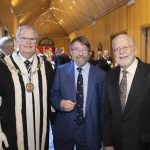
"The Beadle puts a livery gown on the candidate and says - I now clothe you in the Gown of the The Worshipful Company of Glovers of London". There are a few occasions in one's life which are truly memorable, that one will look back on and say that was really important.  One has happened for me in 2009 despite delays through car accidents and hospital stays and all sorts of impediments.  That was being admitted in early November to the Livery of the ancient London Guild of Glovers. The Glovers Company was founded in 1349 and despite a brief period between 1501 and 1639 when the power of capital over labour meant that it slipped into the hands of the Leathersellers has been independent since.

Historically Guilds throughout Europe got recognised somewhat as monopolies that controlled industries and slowed innovation.  They were certainly centres of knowledge and hopefully of excellence. Francesco di Marco Datini was a 14th century Merchant from Prato in Italy and the excellent Penguin "The Merchant of Prato" tells us how he worked with, for and against the guilds in Prato and in Florence. In the time of Queen Elizabeth 1st in England the control of the Spanish tannage (a mimosa process) was given to Leathersellers to ensure that every delivery that was sold came with proper technology transfer.

In the last ten years the Guilds in London have come strongly back to life and stopped being benevolently minded rich men's' clubs.  Of course tradition remains of importance but there is no reason that tradition cannot combine well with contemporary society. At the same time the older guilds have overcome the horror of the departure of so much of the manufacturing which sustained them for centuries to other parts of the world.  Assembly of components into products is only one part of an industry structure than brings products to the consumer and in our case puts gloves on their hands.

The Glove Industry is very much alive

At the same time gloves are returning to favour in the ways they used to be used a couple of centuries ago - industry where now health and safety issues are given greater attention, fashion where style and image is back in favour, and in sports where a mix of protection and dexterity can make the difference. And who anyway is to say that glove making will always stay in India and China. Increasingly the value of locally made gloves for quick retail response, access to superb materials, and exceptional designs and quality is being recognised again. Some return of manufacture is quite likely.

I am hoping that I will be able to contribute to this superb institution which blends the best of the past into our hopes for the future. I hope our links with the University of Northampton will continue and expand and that we can help to put gloves closer to the forefront of the minds of the consumer.

There is no doubt as we were told at an excellent Livery Luncheon in Drapers Hall that our perspective on the world is being refashioned in the light of the current economic crisis, hopefully a small, not so wealthy, but very active Livery Company can make a difference


27/10/09 - Brand Leather concepts from Beijing


Speech at Opening of the 30th IULTCS Congress in Beijing, China

Elton Hurlow has long had a good understanding of the issues in the leather industry. This is his speech at the opening of the IULTCS which has just started in Beijing:..............

Members of the IULTCS, Delegates, Honorary Guests, Ladies and Gentlemen,

Leather as a Component Brand

It is my distinct honour to address you at the opening of this week's grand celebration of the science and technology that surrounds the making of leather. Our industry takes a renewable natural raw material - which comes to us as another industry's waste by-product - and we turn it into a durable, aesthetically pleasing, and versatile structural material highly valued by leading brands of consumer articles. Our secret is that we have the privilege of working with one of natures most unique materials - collagen. Collagen comes to us in the form of twisted triple helical strands, which we then purify and build upon that framework. Our industry at once resolves a disposal problem and simultaneously creates a highly valued and useful product. We should actually use the word intermediate product as leather is typically a component of what the consumer buys. I suggest we describe leather as a component brand, as leather is the identifier of value. At retail, sales people always refer to their article as a leather jacket, a leather sofa, a leather shoe, or a car with leather interior. They add the word leather because it evokes a favourable emotional response in the mind of the consumer - it elicits feelings of aesthetic pleasure, it appeals to the visual, tactile & olfactory senses. The mind conjures expectations of performance and durability, and there is an overwhelming sense of intrinsic value. What a wonderful industry we work in, and this week we are here to celebrate the global knowledge surrounding collagen and its transformation into the component brand "leather".

Value Chain Issues

Over the last two years, I have reflected on my concerns surrounding two important aspects of the leather value chain. One is the Identity of leather and the second is the Image of the industry. Let me add that my concerns are NOT unique and are shared by other individuals and organizations involved in the leather industry.

1) Let's look first at the "Identity of Leather":
As scientists, we are uniquely qualified to answer the question: "What is leather?" I think we also need to reflect on the question: "What is NOT leather?" For what is leather, how it is labelled, and how it is understood at point of retail goes to the very heart of what it takes to maintain leather's fundamental value. You just have to walk into any department store today to understand that leather is under threat by "What is NOT leather". Substitutes add the word leather to elevate perceived value in the eye of the unwary consumer using terms "synthetic leather", "leather-like", "faux-leather", "composite leather" etc. These are not leather. Also, leathers of poor quality, those only made "good enough for purpose" or "to price point" also devalue the component brand by exhibiting poor performance and can result in a negative consumer experience.

So what can we do about it?

I suggest the first point is awareness. As technical individuals and as an organization we can offer support to those agencies such as ICT, Cotance, national bodies such as the CLIA that are working to differentiate leathers by implementing labelling and identification standards. Our institutes can also do research and publish work on re-cycling, sustainability, renewability and the other positive contributions of the leather industry. As scientists, we can clearly identify and should communicate the unique performance properties of leather. We must support high leather standards. We should celebrate those who excel and recognize their achievements. We should support those who work to raise the perceived value of leather and protect its unique and valued identity in the minds of end consumers.

2)Let's talk briefly now about the "Image of the Industry":
The image of the global tanning industry can be improved, especially with regard to pollution and environmental sustainability. It is not just from a moral and ethical viewpoint that we need to be good stewards of the environment, but a business case can also be made for sustainability in manufacturing. The technology exists to manufacture leather in a clean and environmentally sound way. Many companies do. But the actions of a few can override the good behaviour of many.

To improve our record will take concerted actions of individuals, organizations, and, because of the costs this involve, it will most likely take pressure from governments and regulators and we hope will include the support of brand conscious retail. Implementation of minimum standards and attainment of best practice guidelines takes time, money and effort. The IULTCS and its members can assist with continued research, technical support, knowledge transfer, and efforts aimed at benchmarking and recognition of those who do succeed in running clean operations. There are in fact many positive examples of this happening worldwide. The IULTCS needs to support these efforts.

A positive and cleaner image is also important to entice talented young people to study leather, and join our industry. We should also recognize those leather training organizations that have programs in place to educate young fashion designers and stylists about the wonderful story of genuine leather, its unique performance and aesthetic properties, and how to work with it.

Now, to the IDENTITY of Leather and the IMAGE of the Industry, I am going to add INNOVATION in leather making.

3)"Innovation in Leather making":
Innovation comes in different forms. It is not always the strong forces of "creative destruction" that can rapidly overturn the old ways and herald in the new. In my 25 years of leather industry experience, innovation has typically been incremental and adopted slowly. Machinery operates today on pretty much the same basic principles as two decades ago; but small design changes, introduction of electronics and computerized controls have resulted in great improvements. Chemical principles of making leather are essentially the same as years past; but the introduction of new products such as polymeric lubricants, stucco, new finishing technologies, have improved efficiency and performance. We have also seen improvements in waste treatment methods, tanning recipes, work practices, handling methods - these are all examples of continued creativity and innovation in the leather industry. The IULTCS this week will celebrate innovative solutions to problems, new ideas will come from lectures and personal interactions, and better understanding of our working materials and how to do things will evolve. Innovation drives efficiency, solves problems and opens new markets.

The IULTCS and its represented members are uniquely qualified to make major contributions in the area of Innovation, and this is the main reason we are here this week.

Beijing 0ctober 2009

Madam Zhang, Mr Su, Prof. Shi Bi and the rest of the organizing committee, we thank you for your hard work in preparation for this Olympics of leather technology. There is much significance surrounding this 30th IULTCS Global Congress. The first IULTCS Congress was held 60 years ago in Paris in 1949. During the 110-year history of our Union, this is only the second time that an IULTCS Congress will be held in Asia, and the first time in China. Today, China is a global leader in the production of leather, and her scientists and technicians make significant contributions toward the research and development of new technologies for leather manufacture. I ask that we focus this week on what I believe are three very important needs of our industry:

  • The Identity of Leather,
  • The Image of our Industry,
  • And Innovation in the leather making process

This is important to maintain value in our industry. Thank you.

Elton Hurlow
President - IULTCSOctober 2009


10/09/09 - Consolidation - a new word for the leather industry


Terms like mergers and acquisitions, consolidation and vertical integration seem very alien in the leather industry but are now being discussed in main stream seminars such as the one at the Shanghai Leather Fair, "Coping with Change".  It is not totally new as the industry has been segmented in different ways for centuries and the last fifteen years has seen huge changes in the leather chemical and leather machinery business. Yet we have in our mind tanneries as small to medium sized family businesses which in the last few decades have preferred to shut than grow, develop or move.  As a consequence 90% of the tanneries in the old world have just closed to become building development opportunities with only memories left.  In place completely new tanneries have opened under new ownership in Asia and other parts of the world. Attempts to grow internationally were made by Colomer and Prime but for various reasons the timing, the culture, the strategy failed for them.

Yet now we are talking about consolidation. It is a subject long overdue since there has been overcapacity and low profit margins in the leather industry for many decades as small units accepted low returns and marginal costings. Even the chemical industry is now affected as it has to service a global marketplace rather than an essentially European one, deal with compliance and new local competitors in places like China, India and Pakistan. The machinery industry has had a worse time as leather was always a small industry with the number of splitting and fleshing machines needed per annum across the world hardly justifying new development. Drums are a little easier as more are needed per tannery and technology from elsewhere - computer control, chemical dosing, water management, and materials handling - has widened the market opportunities.

We have known that the chemical industry was in play with announcements from BASF and Zimmer & Schwarz buying Munzing in April but the big news has to be what is happening in the tannery sector. It might be said that current moves were led by the announcement earlier this year by Prime Tanning selling its wet blue tanning facility in St. Joseph, MO to an affiliate of National Beef Packing Company. Those of us who have spent a lifetime in the industry remember Prime for an outstanding sequence of invented products such as Jim Dandy, Floater and Crazy Horse and they were being watched in the 1980s and 1990s as they moved towards a new global business model. The story now is not theirs but rather that of the beef packers who throughout the world are moving to wet blue and crust to increase their flexibility and control over raw. The discussion on vertical integration was strong in the seminars at the Shanghai ACLE show, but to be valid there needs to be more to it than the raw producers pushing their weight.

In reality the industry has been changing and the recent publication in Leather International of a list of the world's most influential tanners makes that point. Bader, Boxmark, Tyche, ECCO, Sadesa, and Mastrotto are examples of tanneries that have made a success of multiple sites around the world and different configurations. One distinguishing factor of these new evolutions is an improved capability to transfer leathers from one location to another.  We have always said that differences in drum sizes and speeds, in water quality, in spraying machines and the like make it almost impossible to make identical leather in different tanneries. While still having problems these new groups have shown that it can be down but needs great care in decisions on machinery and process approach, and consistently high levels of investment.

There were also strong views on how large a tannery should be and how complex, which again have been blown away by the adoption of new layouts and approaches. Leather making still relies on touch and feel in its final judgment but if we are pretending it is still more art than science we are living in the past. We know enough about tanning now to be able to apply modern processing and engineering technology and start to manage production in every location and climate.

So it is a moment to look at "consolidation" with new eyes.  This means examining core competences (technologies, relationships and the like) and your P&L and Balance Sheet in order to take new decisions of where you sit in the world of tanning and leather. If you do not, then others may do it for you.

Consider the Brazilians who continuously re-examine their role in the world and re-invent themselves.

(For last day report on ACLE Shanghai click here)


16/08/09 - Bertin in the Amazon

BRAZILIAN LEATHER GIANT COMMITS TO AMAZON CATTLE MORATORIUM FOLLOWING INDUSTRY PRESSURE

Tough new sourcing policies from Clarks and others have been iinstrumental in a decision by Bertin to expand an official agreement signed in July with the Brazilian Federal Prosecution Office and the government of Pará state in Amazonia, which was limited only to excluding farmers involved in illegal deforestation to include all ranches involved in any new Amazon rainforest destruction. The press release I publish below in full is from Greenpeace. Hopefully the individual links at the bottom to each companies press announcement will work. If not please just cut and paste.  This is a successful outcome but does change the situation for tanners and long term hide sourcing.  Land does not expand on this planet while population does and the agreement to terminate the rapid expansion of land use for ranching in Brazil and current presure on land in China means we will have to reconsider the long term supply of red meat and bovine material for leather.

13th August, 2009 from Greenpeace

One of the world's largest leather suppliers, and Brazil's second-largest beef exporter today backed Greenpeace's call for a moratorium on the purchase of cattle from farms involved in new deforestation in the Amazon with immediate effect. (1).

Bertin's announcement follows tough new policy statements from shoe retailers such as Clarks, Nike, Timberland, Geox and Adidas, in response to a Greenpeace report entitled Slaughtering the Amazon, which was released in June.

The report traced leather, beef and other cattle products from ranches involved in the destruction of the Amazon Rainforest back to top brands' supply chains.

The cattle giant now joins Marfrig, the fourth-largest producer of beef and beef products in the world, which adopted a similar commitment in July (2).

"Bertin's decision should pave the way for the modernisation of the Brazilian cattle industry", said Sarah Shoraka , Greenpeace Forests campaigner.

"Given the sheer size of both Bertin and Marfrig's operations, this commitment will have real impact on driving down Amazon deforestation and greenhouse gas emissions. Greenpeace will closely monitor the moratorium's implementation to ensure its success", said Shoraka.

In the next 180 days, Bertin will register and map all fatteningfarms which supply cattle directly to the company. For the rest of the supply chain, including rearing and nursery farms, Bertin believes that it will require two-years to implement a traceability system from farms to its slaughterhouses and processing facilities.

The company will also ensure it is not buying cattle from indigenous and protected areas or from farms linked to slave labour, land conflicts and land grabbing.

Marfrig and Bertin's commitment to end Amazon deforestation has isolated Brazilian JBS-Friboi, the world's largest producer and global exporter of processed beef. Contrary to its competitors, JBS-Friboi is staying silent on the issue and is expanding into the Amazon having rented several new facilities north of Mato Grosso State , an area which has the greatest rate of cattle ranching expansion and deforestation in the Amazon.

"JBS-Friboi must accept its responsibilities and stop fuelling Amazon destruction. It needs to join these companies in protecting the rainforest now," said Shoraka.

Brazil 's entire cattle sector urgently needs to follow the soya industry's example and commit to a moratorium on expansion into newly deforested areas.Both the federal and state governments must ensure this is possible by mapping, registering and monitoring rural properties, helping the private sector to fulfill its corporate liabilities. Cattle ranching is the biggest driver of Amazon rainforest destruction and contributes to making Brazil the fourth largest climate polluter in the world.

Fernando Bertin, CEO of Bertin , S.A. said:
"Environmental responsibility is increasingly relevant for a company like ours to maintain and enhance its position in Brazil and abroad. Today, we are making a fundamental step."

For companies' commitments see:
Adidas
www.adidas-group.com/en/sustainability/statements/2009/leather_sourcing_brazil_july_2009.asp;
Clarks: http://www.clarks.co.uk/Careers/AboutUsHome/LeatherSupply
Nike: http://www.nikebiz.com/media/pr/2009/07/22_AmazonLeatherPolicy.html
Geox (in Italian)
http://www.greenpeace.org/italy/news/vittoria-di-greenpeace-nike-e:
Timberland
http://earthkeeper.com/blog/corporate-social-responsibility/issues-in-earthkeeping-part-ii/