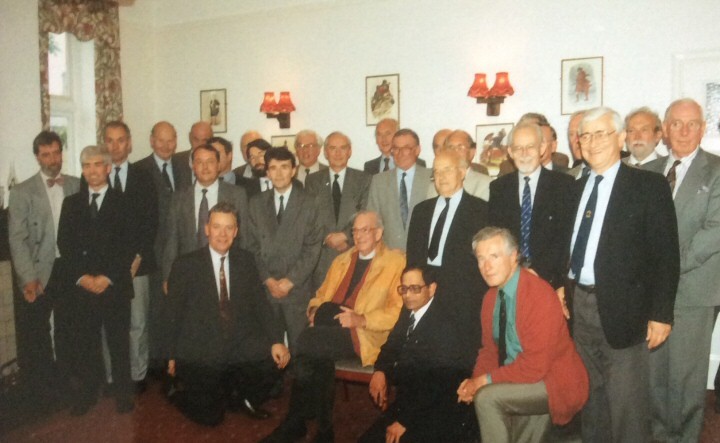
BOOTH MEN 1970s or 1980s: If you can provide the year, location and details of the event along with all or any names of those in the photo please use the contact form to let us know. We would like to have a fully accurate record.
Here is what we have to date:
Some colleagues think this could be JSMB’s 70th Birthday held on 28th April 1983 in the Hawkwell House Hotel Iffley Oxford? Others think it was during the Turney years, prior to Garnar-Scotblair merger. Taken in a hotel, (Scottish Clan scenes on the pictures). Noted that there is no Bill Stewart, David Boyce, Jim Hillman, Frank Critchley etc etc etc, unless they are obscured faces?
From right of screen to left, front to back order:
Peter Wilcox (R&D)
Stan Elliot
Jim Jackman (R&D)
Ron Bennett (Pav) partial face to rear of above.
Paddy O’Flynn (kneeling) Booth overseas/Ofro.
Standing to the left of Paddy O’Flynn is Ralph Liddiard
Dr John Coggins (R&D)
immediately behind John Coggins is Mike Parsons
Other one to rear of John Coggins not recognisable.
Arvind Patel (Booth & Co England) sitting.
Bald chap behind, forgotten.
Two to rear of above obscured.
JSMB sitting.
Leo Mcdonough (Atlantic)
John Pittard (whose presence likely pushes us into the 1980s).
Alec Finch to left/rear of JSMB (Melrose Tanners)
Standing to the left on the print of Alec Finch is Eric Filtness
Brian Price-Hood (Pav)
Mike Redwood (Turneys) to rear/left above.
Standing behind and slightly left of Mike Redwood is Doug Ashley
Person behind Mike obscured.
Tony Boucher ( Booth England) kneeling
David Bolle (Pav)
Two people to rear David Bolle obscured.- Mike Green (directly behind DWB), & David Donald.
Ken Delves (Pav)
Dr John Barlow (R&D) behind
Paul Bloodworth (Turneys)
Jeremy Rotton (Turneys).
JSMB’s 80th birthday party was held in the Reform Club on 28th April 1993, but this was taken well before then.
As of May 2018 I have just noted that there appear to be two sets of time line, people and the companies in the web site each of which has been updated a bit separately. Apologies for this, and I will spend some time correcting it when I finish my next set of travels.
Booth Group Time Line and People
Timeline/People/Brands
The main events in 150 years – time line, people, brands and companies. The way the pages are configured there are separate pages for the time line and people, which are not always in synchronisation, so do check both. Ongoing smaller changes continue every few months. there is a list off references in the book section but in this I have lent heavily on John’s company history – A Liverpool Merchant House and Norman-Butler’s Victorian Aspirations.
It will contain some errors and many omissions, so please accept my apologies and send any corrections and additions to mike@mikeredwood.com
19th century About 1799 Thomas Booth left the family farm in Warrington when he was 18 years old and went to Liverpool where he was able to set himself up as a corn factor and was well established within a decade. He was a nonconformist and was drawn into Unitarianism and became a founder member of a new Chapel in Renshaw Street.
1789 Thomas Booth became spokesmen for Liverpool with the Board of Trade on matters related to the Corn Laws.
1799 Charles Booth (Snr) born to Thomas and Esther (nee Noble), the youngest of four children. Their second son, James, became Permanent Under Secretary at the Board of Trade after studying at Cambridge, while Henry the oldest son went into the railways and worked with Stephenson. His biography was written in the 20th century by another Henry Booth, of course a descendent and son of Charles (son of Alfred) born in 1901. Henry Booth’s statue is in St George’s Hall, Liverpool.
1812-1815 Napoleonic War of 1812 After the war Commodity prices fell and stayed low for a long time
1820-1940 Unitarian Society became very important in the UK
1834 Alfred, son of Charles and Emily Fletcher, born. His sister Anna was born the year before and was to marry Philip Holt of the shipping line.
1837 Grand Junction Railway completed London, Birmingham, Manchester and Liverpool linked together by train
1840 Charles Booth born 30th March. He was in fact the third son, but his brother Thomas died young in 1863, having gone on to become a Wrangler at Cambridge (student who gets a 1st class honours in the third year of a mathematics degree) he had a younger sister, Emily. Charles went to the Royal Liverpool Institution, the same school as his brothers, and also did well in mathematics, but was put into business rather than sent to Cambridge. At the age of 16 he was apprenticed to Lamport and Holt, a trading company.
1846 The Corn Laws were repealed. This allowed importation of cheap food. It also reduced wok opportunities in agriculture so accelerated urbanisation with workers moving to towns and cities in search of work to which were added Irish peasants fleeing from the famines in Ireland.
1847 The Factory Act implemented
1847 Friedrich Knapp first published his ideas on chromium In the Textbook of Chemical Technology
1848 The Public Health Act passed.
1850 Alfred apprenticed to Lamport and Holt, well known Liverpool merchant house
1850s Liverpool merchants began to replace sailing ships with small steam ones
1856 Charles apprenticed to Lamport and Holt.
1857 Alfred Booth went to New York where he worked for the Liverpool merchants Rathbone & Co
1858 Friedrich Knapp published details of the tanning effect of chromium The German Chemist published his treatise On the Nature and Essential Character of the Tanning Process and of Leather
1859 Origin of the Species Darwin’s quietly spoken but influential book was published. Charles interpreted this to mean that man must accept responsibility for the mess made of the world (Norman-Butler).
This lead Charles to believe education was vital, and that education should be free for all and free of sectarian influence. He joined the Birmingham Education League founded by Joseph Chamberlain to promote secular education.
1859-1862 Bad harvests in UK lead to food imports from US through to 65
1860 Elder Mr Charles Booth (1799-1860) died
1860 Partnership set up with Mr Walden: Walden and Booth 57 Broad Street, New York
1860-62 Charles Booth travels in Turkey and Europe wanting to learn more before going into business. He had finished his apprenticeship. He returned to Liverpool on learning of the death of his “girl friend” Antonia (Tonie) Prang.
His brother Tom saw his sketches from Turkey and the near East and went off to replicate the trip, where he became ill and died in Constantinople.
Charles was offered a partnership in Lamport and Holt but instead he went to New York to consider joining his brother Alfred’s leather business there. Alfred Boot and Company. As it happened he joined his brother in New York around the time Walden became ill
1861-1865 US Civil War
1863 Walden becomes unwell and enters mental hospital
In January new Booth partnership formed, shipping light leather to US. Alfred Booth & Co. Two products: Sumac tanned sheep from Bermondsey for shoe uppers, and pickled grains and fleshes from Turneys of Trent Bridge, Boots of Leicester, and Johnston at Bootle. The Turneys had two other tanneries which we think were also involved. Brother Edward left the partnership in 1871 and owned Whitemoor Leather in Nottingham (this burnt down in 1888 and ended up going bankrupt in late 1900, being sold to Wade – largely financed by Booths – in 1901). Two other brothers William Jonadab and Henry, were in business in Stourbridge and very successful. William Jonadab tannery continued until 1957, and their father set up a glue factory nearby as well in the later 19th century.
1863 Issue of confederate loan
1863 Open office in Liverpool 5 India Buildings
1864 Decided to enter the steamship business Plan to sail to North Brazil ports, Ceara, Maranham, Para (now called Fortaleza, Sao Luiz, and Belem): return cargoes would be cotton, sugar and coffee
1865 Booth US trade had a good year
1865 Turneys agreed to ship to US on consignment
1865 Contracts placed for first 2 Booth ships, Augustine launched
1865 Charles Booth campaigned unsuccessfully for the Liberal parliamentary candidate in the election of 1865. He subsequently decided politics was not a route he wanted to follow to achieve the social outcomes he believed in.
1866 Charles Booth joined Joseph Chamberlain’s Birmingham Education League.
1866 Feb 15th first Augustine voyage to Brazil Voyage lost GBP3 but obtained 10k annual contract for mail from the Brazilians
1867 Brazil/Paraguay War ends
1867 Alfred Booth married Lydia Butler. After his marriage he returned to the UK
1867 Thomas Fletcher joined as partner Appears to have worked in New York. Cousin and close friend of the brothers.
Trained as an engineer before joining Booth & Co
1860-1890 US population doubled
1869-1871 Alfred Booth stayed in the US Last prolonged stay
1869 In 1869 R. Singlehurst & Co. Ltd., of Liverpool who had traded sailing ships for many years to northern Brazil, founded the Red Cross Line. This was in direct competition to Alfred Booth & Co., but in 1870 agreement was reached to share the trade. A fortnightly service being instigated
1869 Charles Herbert Wade joins Shaw’s Tannery in Grantham, UK (predecessor of Bjorlows) He was 13 years old but soon moved to Edward Turney & Co at Whitemoor Leather Works, which in 1901 was to become Wades.
1870 Franco-Prussian war breaks out
1870 The Honourable Henry Romilly joined as partner Son of first Lord Romilly and grandson of Sir Samuel Romilly. His sister married Henry, second son of Mr Justice Crompton and first cousin of Alfred and Charles Booth. Spent the 70s in the USA, financial side of business, who was unwell much of the time and not hugely active.
1870 Office opened in Boston to build on success of Roan business (pickled foreign sheepskins) 141 Purchase Street, Boston. Mr Gaenslen went to be manager
1871 Charles married Mary Macaulay. On 29 April 1871 Booth married Mary Macaulay, daughter of Charles Zachary Macaulay and Mary Potter, and niece of the historian Thomas Babington Macaulay.
1872 Free hides in the US Tariff on imported raw material into the US removed
1873 Charles goes with family to Bex in Switzerland Due to ill health he takes a break from work. Decided to live on 5% of his savings per annum until able to work
James Kuttner starts work in New York for Booths on a temporary job
1874 Charles returns to UK in the autumn, although not yet in full health (there is some discrepancy in dates here between Johns and Butler) and sets off on three month trip to Brazil.
Charles takes his wife on 3 month trip to Brazil to test new pressurised engine One of few trips he makes with his wife; his health recovers considerably during this trip, although the new boiler did not prove a success.
1875/76 Break with Liverpool for Charles. He was unhappy about the family’s traditional Unitarianism and their contentment with Liverpool. Decides to set up home and office in London to manage Booth trading. Causes major family rift and break with Philip Holt. Mary took a fifteen year lease on 6 Granville Place, South Kensington not far from Kensington Gardens. It is here Charles Booth has his blue plaque.
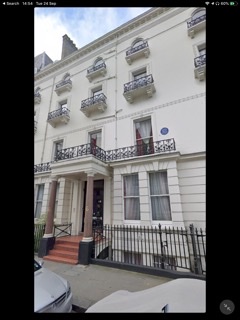
6 Grenville Place, South Kensington from Google Streetview
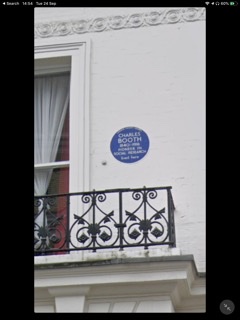
Blue Plaque at 6 Grenville Place, South Kensington. From Google Street View
1877 Office opened in London to deal with French and Belgian sheep suppliers Fenchurch Street: or perhaps 84 King William Street
1875-80 Without fail he wrote a weekly letter to Alfred on the state of the business. In 1875 and 1876 profits had been OK, but in 1877 they dropped and the company was trading at breakeven. Charles decided he would go to the US .
1877 George Macaulay Booth was born. Paulina (Polly) Mary had been born in London in October 1876 but died after only a few months.
1877 Kent and Stevens tannery in Gloversville hit by Stevens fraud. Booths were owed $70,000. Booths decided to pay off the creditors and back James Kent who they thought was an honest man and a clever leather chemist. A mortgage on the building was held by James Kuttner and his wife on behalf of Booth and Co. James Kent was the leather scientist who developed fatliquoring and the Dongola tannage. Worked with his assistant Joe Hunt (who later became superintendent)
James Kent described as one of the “outstanding pioneers of the American Leather Industry: both innovations forming part of a long search for a method of producing cheap kid leather to replace the expensive products imported from France and used in the Gloversville glove trade” John, 1959 p 50
Stevens, who stole from James Kent ran off to California, but is reported to have returned a few years later and served his sentence for the crime.
1878 Charles again in the USA and reorganised the business with Kent tannery now included. Spent three months a year in the US for many years and nine months in UK divided between London and Liverpool went on for the rest of his working life. This gave rise to the many letters he exchanged with Mary Booth as they wrote to each other daily.
1879 Problem of unsold stocks of roans lead to opening of separate showroom in New York Frankfurt Street
1879 Dongola tannage successful and Booths began buying dried goat and kangaroo skins for it Did not work for gloves but excellent for footwear
Booths took a share in the Kent business and James Kuttner moved to Gloversville to supervise the commercial side
1879 Liverpool offices moved From 5 India Buildings to 14 Castle Street
1879 Charles Booth bought two sailing ships the Bessie Dodd and the Carrie Dodd to take gunpowder and other bulk cargo to Pará and return direct to London with rubber and nuts.
1880 Charles becomes senior partner. Charles becomes senior partner at the request of Alfred. and effectively becomes sole CEO. Tom Fletcher’s letters say “Alfred is a silent indecisive person”
1880 New-York to Pará direct service introduced by Booth Line
1880 Booths picnics in Gloversville begin in Sacandaga Park, sometimes leasing several railroad cars for its employees and families In the Park they quickly became the highlight of the summer season. Open to all citizens of Johnstown, Gloversville and surrounding communities they drew exceptionally large crowds. (1891 over 5000 people) from Larner, Paul, Our Railroad: The History of the Fonda, Johnstown & Gloversville Railroad 2009
1880 Launch of Daisy Kid Ceara goat tanned with Dongola Tannage to make an imitation kid
1880 Booths buy Dodge factory next to Booth and Kent Paid $30,000 to be able to expand the Gloversville tannery and use Dongola on dried raw including kangaroo
1880s A period when the Industrial Revolution had been well recognised and a lot of British machinery was now getting out of date. A big period of change. Other countries were inventing new machines, making products inexpensively and exporting them to the UK.
1880-1884 Augustus Schultz worked with Julius Kuttner in Booth Gloversville on perfecting chrome tanning. They first met in Racky’s Restaurant in Frankfort Street (alongside the Brooklyn Bridge and at the edge of the tanner quarter called the Swamp) where all the tanners met for lunch.
1881 Booth Steamship Co Ltd formally incorporated, Capital of £200,000 in £10 shares. £81500 issued in first instance largely to existing partners in original four ships and to friends.
1881 Charles sailed to Bordeaux Looking for quality sheepskins. He spent week in the Cévennes staying in “primitive” farms and inns. This is close to Millau, the 20th century glove capital of France.
1882 Nuneaton Leather Co founded. Booths needed to make something out of the roans. Charles Wade left Whitemoor and set up the small tannery at Nuneaton for Charles Booth. A Mr Johnson owned 50% and Booths 50%. Mr Johnson supplies sheepskins and Nuneaton Leather split them sending the grains, salted to the US and splits were sold for chamois production in the UK. The plan was to make heavy grains better suited for the New York market sold as ABC.
1882 Booths leased Haselour House in Staffordshire House as a country home for two years. in 1884 the owner put it up for rent but the Booths did not have the wealth to buy it.
1884 Augustus Schultz had two chrome tanning patents issued He sold these for $25000 and they were eventually sold to Patent Tanning Co of Philadelphia. Schultz went on to develop patents for central heating. See technical timeline
1884 The Lord Mayor of London (Sir R.N.Fowler, banker, MP (1868-74) consulted the Statistical Society on the which methods of assistance had proven the best to relive poverty in the past. This then set up an inquiry based on the 1881 census, which worked from rooms in the Mansion House. Charles Booth offered his services, becoming a member of the official committee in charge of the 1891 census. Charles called his part The Board of Statistical Research and it met once in his City Office. Instead Charles began to move forward on his with advice from Chamberlain to use information from the School Board Visitors as a means of checking the census figures and this proved valuable advice.
1885 Charles began The Enquiry. He wrote the Life and Labour of the People of London between 1886 and 1903 Had one clerk put into the Mansion House but otherwise this work was done in Alfred Booth offices until moving into its own premises in 1888
1886 James C Kent died on June 6th aged about 55 leaving a widow and two children. He died of malaria contracted during a visit to St Augustine in Florida. He died at his summer home in Ocean Grove, New Jersey. He was said in his NYT obituary to be worth about $1m. He was named as a member of
– Booth & Kent of London
– Kent & Booth of Gloversville
– Kent & Co of New York
Booth & Co became outright owners of the Gloversville tannery after his widow asks them to buy her out.
1886 Henry Romilly, a partner, dies He had become unwell in about 1883 and returned to the UK
1886 Charles found Gracedieu Manor, in Leicester to lease as a Country Home.
1886 Charles presented his first paper to the Royal Statistical Society “The Occupations of the People of London, 1841-1881”. This paper cast doubt on the way the census was being used to develop this information and suggested other additional data was needed to get a more balanced picture.
1887 Alfred Booth retired Although he remained in touch for many years
1887 Mr Miller employed in Sydney to buy kangaroo in conjunction with Richard Young and Co
1889 Schultz’ two chrome patents passed to Franco-American company Messrs Blumenthal Blumenthal then passed patents to Marcus Beebe and R.Foederer & Co in Philadelphia apparently via the Patent Tanning Co. of Philadelphia.
1889 Robert H. Foerderer began making “Vici” kid with chrome tannage Backed financially by Abe Steen of New York and Marcus Beebe of Boston
Getting the fatliquor right appears to have been key
1889 As the lease for Grenville Place was running out and they chose 24 Great Cumberland Place, just north of Marble Arch.
1890 Booths opened office in Australia to source kangaroos as well as sheep Run by Frank Millar and later helped by William Cunningham
1891 Richard Patswosky of New York produced “Bonafide” Kid for Booths Thought to be a chrome product used by Booth to replace Dongola glazed kid
1892-1894 Booth started to market their Brazilian goatskins chrome tanned and finished in Philadelphia by tanner J.P.Mathieu Called Surpass it was a chrome tanned black glazed kid.
In 1894 Booths gave up Bonafide kid
1892 J.P.Mathieu bought land in Allegheny Avenue, Philadelphia for a new tannery
1892 Charles Booth elected President of the Statistical Society due to the care and imagination he had given to his Old Age Pension Scheme, and the contribution he had made with Poverty Series of Life and Labour. He was also awarded the Guy Gold Medal which had not been awarded for some years.
1893 Martin Dennis patented single bath chrome tanning An attempt to circumvent the Schultz patents, which required a per unit royalty.
1894 Booth Gloversville tannery started chrome tanning for goat and kangaroo Charles Wade made first trip to US to understand selling arrangements
1896 Daily output at J.P.Mathieu rose to 600-700 doz
1896 Partner Thomas Fletcher dies George went to USA (New York and Boston) shared cabin with Cecil Baring of Baring Bank
1896 Professor Procter tours US Observed the new chrome tanning
1897 New partnership agreement for Alfred Booth and Co Charles makes new partnership agreement with his nephew
1898 Daily output at J.P.Mathieu rose to 1000-1200 doz
1898 Introduction of enamel process by George S Wolff to copy patent leather Sold by Booths as “Ideal”
1898 George goes to US with his father Charles, after giving up at Trinity, Cambridge where he was studying to be a doctor and in 1899 starts a Clerk in London Office
1899 Office in Christchurch, New Zealand George makes round the world trip during which he opens office in New Zealand and catches dysentery in India
1900 Surpass tannery, built in 1892, burnt down Allegheny Avenue site was rebuilt as a modern factory for large production of chrome tanned kid
1901/1902 Julius Kuttner died on 8th October. George sailed out on 30th October and took charge of US for two years The younger Booths began to take over: George Macaulay Booth (24), Alfred Allen Booth, Enfield Fletcher.
No Booth partner lived in New York from 1883 to 1901.
1901 Charles was in New York for Christmas and reported om the worst weather there since 1881.
1901 Charles Booth starts work on Harbour concept for Manáos
Charles Booth portrait painted by G.F.Watts (now in National Portrait Gallery since 1960). This was not a commission but a request ny the artist who had hoped it would reach the NPG. The family consider it the best portrait of Charles, even although the artist died before the final sitting.
1901 The Singlehurst family decided to withdraw from operating their own fleet. The two companies amalgamated under the name of The Booth Steamship Co. (1901) Ltd. From the amalgamation of the the Booth Iquitos Steamship Co, Ltd. and the Red Cross Iquitos Steamship Co, Ltd. was born The Iquitos Steamship Co. Ltd. In 1911 The Iquitos Steamship Company was absorbed into the main Booth fleet.
1901 Charles Wade and Co founded in Nottingham as a joint venture buying Whitemoor Leather Works in Nottingham at auction. It had gone bankrupt in 1900. The agreement was that Charles Wade would buy out the Booth part over time from the profits.
1902 Booth & Co Gloversville stopped making glove leather and transferred to shoe leather only From McMartin book on Gloversville
1902 George hires CWJ (Sir Clement Jones) Sailed to London in July “I wanted to get one or two Englishmen out to join me”
1903 Manáos Harbour Limited established Charles travels to Manáos to see the new harbour on the Obidense
1903 Daily output at J.P.Mathieu rose to 1500 doz Thought to be the largest kid skin tannery in the world at that time
1903 August Charles and Mary made 3 week visit to New York September Cousin Alfred came to New York, and asked to stay a year. So in January 1904 George returned to UK
1903 Charles and Mary also sailed on the maiden voyage of the Ambrose
1904 Charles Booth made a Privy Councillor receiving the letter from Prime Minister Balfour on June 22nd. Next day Charles Booth given honorary DCL. at Oxford (Doctor of Civil Law)
1904 Booths buy into Surpass forming Surpass Leather Company as a JV with Mathieu from Jan 1 2005 Charles Booth went to US for extended trip with many trips from NY to Philadelphia; took John Crompton who had been working on raw material in China and other places since 1902
1904 Booths supported building Wolff Process Leather Company In Summerdale near Philadelphia. The process was not too successful and subsequently discontinued
“When the Surpass tannery was running kangaroo, they regularly consumed about 150 to 200 dozen per day- everything that was available from Booth Australia, which was centered in Sydney, with agents in Brisbane, Rockingham, Adelaide and Freemantle. I believe that for many years, starting at the very beginning of the 20th century, Booth was the dominant collector of kangaroo skins and therefore had a very large influence on prices.” KC elder
1904 On the 23 February Charles Booth spent an hour and a half with the Prince and Princess of Wales.
1905-6 Charles Booth had major breakdown in health This was his second breakdown and now required him to spend much of his time at his home in Leicestershire, Gracedieu Manor, and hand more of the business to the second generation.
Gracedieu was lit by candles and lamps without electricity until 1932. Th lawns were cut by a pony pulling the machine and took three days.
George spent most of 1905 in the USA but returned finally to UK in January 1906 leaving US to be managed by Paul Crompton, Clement Jones and Franklyn Kirkbride
1906 George marries Margaret (Margy) Meinertzhagen Sets up home at 48 Great Cumberland Street (near family home at 24). Marries Margy 6th October and goes on 5 months honeymoon to Italy, Egypt, Jerusalem and other places in the Middle East
1907 Booths buy out the Mathieus’ share in Surpass From Jan 1 Paul Crompton took over from Mathieu as VP and GM or Surpass
1907 Over supply in kid market led Booths to off load Surpass stock Caused upset in Philadelphia with other tanners but seems to have worked well – defined as “healthy readjustment” with all tanners back on full production shortly after
1908 George and Margy sail to Brazil to understand the shipping business Looked at Pacific route from Iquitos and implications of the booming rubber trade from Manáos
Got caught up in a revolution in Peru. Declined offer to manage all harbours on Peruvian coast. Sailed back via Panama, Jamaica and New York (on Lusitania)
Material from Margy’s diaries and George’s lecture used by Virginia Woolf in The Voyage Out (Crow, p55)
1908 Will Rothenstein paints portraits of both Charles and Mary Booth
1908 Old Age Pensions introduced brought in by the Liberal Government to start in January 1909. Not universal as hoped for by Charles, but for the deserving poor. !8 years after he wrote his first pamphlet on the subject and seriously began campaigning.
1909 An illuminated address was presented to Charles Booth in the House of Commons in November 1909 commemorating his part in the passing of the Old Age Bill. “To you more than any man is this first instalment of justice to the aged due”.
1909 Alfred Booth made Chairman of Cunard, October 1909 Alfred’s brother Charles was Chairman of the Booth Steamship but also went on Board of Midland Railway where he became Chairman. So from 1908/9 George was effectively left to run the whole business
1910 By this time Booths offices in London were the Headquarters in 11 Adelphi Terrace and with an office in Railway Approach, London Bridge that looked after export of hides and skins Up to 1910 they had used No 8 Adelphi Terrace which had been Head office of the Manáos Harbour Limited. In 1903 a passenger office was opened for the Booth Line
1912 Early in 1912 Charles Booth handed over the chairmanship of Alfred Booth and Company to his nephew Charles but still sailed to Brazil in April when Charles backed out because of a local outbreak of fever. He sailed with his son George and met the Governor at the Palace who spoke with pride of the city. Charles wrote that the harbour which allowed all this would be “his monument”.
In 1914 he returned fully to work under wartime exigencies despite growing evidence of heart disease. He said to his daughter after handing over the Chairmanship that he had thought “he would die as Chairman of Alfred Booth and Company.”
1912 George Booth commissions a new house in Campden Hill The New House was built in Airlie Gardens at the top of Campden Hill. Architect was his cousin Harry Fletcher. The house opened in June 1914 and they sold it to South Africa in 1928 as a residence for their Ambassador. The New House was frequently used to entertain Cabinet Ministers, Prime Ministers and Hoover before he became President of the USA along with many literary and musical figures
1914 The partnership moves into a private limited company June 1914, Alfred Booth and Company Limited was formed with a share capital of £1m in ordinary shares of £1
1914 In the US Charles was invited by Theodore Roosevelt to his Oyster Bay , Long Island, Home to talk about trade unions on the 4th August. The discussions were overshadowed, if not overwhelmed by talk about the start of World War.
1914-1919 Lloyd George invited George to direct the infant Ministry of Munitions.George Booth was Dir. Gen. Ministry of Munitions (A Domestic History of the Bank of England 1930-60 Elizabeth Hennessy, page 377). Charles Booth went back in to oversee Alfred Booth & Co. “I believe I am doing useful business he wrote in 1915”.
1914 Alfred Booth dies November 2nd at age of 80. Hi son Charles was Chairman of the Booth Steamship Company and the other Alfred Allen Booth was Chairman of the Cunard Steamship Company. One of his four daughters married Prof Godfrey Lloyd of Toronto.
1915 George Booth spent five months working unpaid at the foreign office trying to sort out military supply situation
1915 Booth and Company becomes a legal entity under US law and held interests in Gardiner-Lucas Candy and Glue Company and the Densten Felt and Hair Company
1915 In May Lusitania is sunk. Mr and Mrs Paul Crompton and their 6 children plus their nurse, travelling first class all perished. Ship carrying accoutrements for army, put on manifest by Booths as sheepskins. Carried armaments classed in the manifest as sheepskin. Mr. Paul Crompton was an Englishman returning home to England. He was the Vice President of Surpass Leather Company at St. Martin’s and Hartwell Lanes. Mr. Crompton was described as a partner in the firm of Alfred Booth and Company and a director of the Booth Steamship Company. The bodies of Stephen, John and Peter were recovered later. All 6 children, their parents and nurse died. NY Times
1915 Despite heart problems Charles Booth returned to work “under war exigencies” From LSE on line archives
1915 George Booth invited to be a Director of the Bank of England (he remained a Director until 1947) Other non leather Directorships for which he is remembered include White Drummond and Co and Municipal General Securities Co (which became M&G)
1916 Charles Booth died on 23rd November, 1916 On 23 November 1916 he died following a stroke, at his country home of Gracedieu in Thringstone, Leicestershire. He was buried at Gracedieu.
1919 The various US holdings were put into a trust The Battery Company
1919 In January letter from Winston Churchill to George ended War work for George Booth and thanked him “personally for the service you have rendered especially in the connection with the organisation of the original Supply Departments of the Ministry, when you were Deputy Director General of Munitions Supply and subsequently as Adviser to the Ministry on Allies Requirements.” (Crow p 161)
1920 Jasper Bentley helped open up the big goatskin market in Nigeria
1920 Walter Kidde and Company engineers Erected a $1.5m plant in Gloversville for Surpass Leather Company.
1921 Booths buy Pavlova Leather, Abingdon Having bought a share in 1917
1924 Gloversville shuts Temporarily, and closed in 1925
1925 International Shoe Company signed a long term contract with Surpass for 100 dozen Black Glazed Kid from Mexican Skins. This turned into a long association. They had previously bought exclusively from William Amer Co.
1925 Officers at Surpass were George M Booth, President; David H Compton, Vice President; William C Burton, Treasurer; Hollister Sturgis, Secretary (head of raw stock department; Harold Connett, Assistant Secretary & Treasurer; Charles Skinner factory manager Philadelphia
1926 U.S. government paid windfall tax repayment to Alfred Booth & Co of 1919 tax refund with interest of $3m
1927 US head office moves to Philadelphia
1929 strike by stakers and cellar boys in Philadelphia. The stakers strike lasted several weeks but it was reported that they returned to work with no concessions. In 1930 Surpass Philadelphia produced 544,000 dozen, of which 420,000 were for its own account and 120000 dozen for International Shoe Company
1929 Gloversville reopens
Booths sell part of Abingdon site for the building of the MG car factory. Felmongering stops in Abingdon as they concentrate on gloving and and chamois/skiver production
1931 George Booth and Ian Fairbairn set up The First Unit Trusts in the UK. It was intended to be bought by ordinary people and kept for 20 years. It contained a mix of shares of top companies and despite all the major economic problems of the time earned 7% per annum throughout. This was the start of M&G. For details read The Origins of Asset Management from 1700 to 1960 by Nigel Morecroft (2017)
1931–1960
1933 George M Booth resigned as President of Surpass
1933 Surpass Gloversville reopened fully plant and soak with George Beck as Superintendent
1937 US Battery Company wound up and US assets put back to direct relation to parent company in UK Consequence of changes in US tax law
1937 George M Booth visited Philidelphia to deal with stock issues and pending inflationary issues
1938 Gloversville closed, after a bitter strike September 28, 1938, Wednesday
“A decision to close the Gloversville tannery of the Surpass Leather Company permanently was announced today by Harold Connett, President. In revealing that the closing order would be effective Oct. 5, Mr. Connett said the company would transfer its operations to its Philadelphia plant because it could “no longer afford to divide its production between two tanneries.”
1939 Mary Booth died In Gracedieu Cottage of the Booth country home Gracedieu Manor in Thringstone Leicester, she had moved to the cottage in 1932. It had been built in the grounds by Charles for some relations (the Macnaghten family into which their eldest daughter Antonia (Dodo) had married) to have somewhere to stay that gave them independence from the main house. The Manor had been taken over by the Prep School of Radcliffe College
1940s Booths began to get involved in bovine production – as dealer in East Africa
– via purchase of Melrose
– manufacture of bovine at Wades
– manufacture of bovine at Surpass
– the production at Bulleys of Kip, Side and Sole Leather
1942 Gloversville buildings sold
1946 Charles Tanneries founded Charles Wade, Charles Booth, Charles Wade jnr. Everyone involved called Charles, hence Charles Tanneries. UK sales had been via Kohnstamm which Charles Tanneries replaced.
1948 Melrose Tanners Ltd bought “A heavy leather tannery at Beverley which has enlarged its sole leather production and plans to make motor-car upholstery hides” Company Newsletter 1956
1946 Vestey buys shipping The Booth Steamship Line consisted of a fleet of steamers plying between Liverpool and Manáos (1,000 miles up the Amazon river). A number of these vessels were lost during World War II, and rather than try to rebuild with the reparations, Booth sold to Vestey. The story is that George Booth (Chairman) met Lord Vestey for lunch. The latter asked what George felt the Line was worth. The reply was “oh, a million pounds”. “Alright” said Vestey, they shook hands, and that was that. Source KC senior
1946 Surpass tanning 1800 doz skins per day When I joined the Booth Group in 1946, Surpass was regularly tanning a total of 1,800 dozen skins a day, employing about 1,000 men. Skin supplies came from their own exclusive agents in Brazil, Argentina, China, India (which included today’s Pakistan) and Nigeria KC senior.
The Surpass tannery was closed in the 1950s and contract tanning at other peoples’ facilities was tried for a time, until operations were ceased in the mid 1960s.
KC senior:
In the 1950’s, Booth established an extensive skin gathering organization in Kenya, Uganda, and Tanganyika; they took over a tannery in Thika, Kenya, and managed one in Kano, Nigeria, and one in New Zealand in the 50’s and 60’s. KC senior
1950 raw supply issues blew up with both the Argentine and Brazil. Booth and Co.Inc which had been subsumed under Surpass was revamped in Philadelphia with Ken Chapman (JC senior) in charge. A big business was built selling New Zealand pickled sheep and lambskins from Booth & Co. (England) Ltd
1950s OFRO (Booths African Rawstock procurement arm) formed) Paddy O’Flynn & John Rozemulder (Dutch) combined in East Africa
1954 Last input at Surpass Watched by some of the original employees from 1900, when the new factory had been rebuilt after a fire
1956 Charles Wade retires as Chairman of Wades (Nottingham) Ltd Replaced by John S.M. Booth. Booth’s buy 100% of the business. Charles Wade died shortly after and Booths then bought the Wade share of the Wade business
Late 50’s Tombooth formed? Booths & Dutch Twentsche Overzee Handel Maatshappij . (Hide & skin sector of Phillips?)
Late 40s’ Bulleys Tanneries Ltd (Thika & Kahawa factories) Thika Built during1944/5 with Italian POW labour .TomBooth bought?
Mr Poulson Snr was Manager from Sept 1948 until 1962
New Zealand Light Leather
Great Northern Tannery
1962 Appears to have been family struggle over control of business John Sebastian Booth was briefly replaced by John Wales Booth
1963 About this year the leather and building side split and Booth International was formed with JSM Booth in charge and Alfred Booth separated as a building business
1964 Ken Chapman Snr moved from Philadelphia to Boston With the close of the Surpass business the main Booth activity was importing NZ sheep to the Boston area
1964 Booth Family Split John SM Booth forms Booth International and his cousins stay with the construction business Alfred Booth and Co
1967-68 Jim Jackman takes over as technical director from Mr Simon Booth Intenational Directors were JSM Booth, Mr Simon/Mr Jackman and David Donald who later had a period at K Shoes
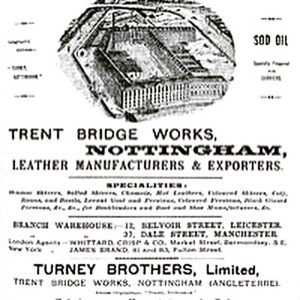
1971 Booths acquire Turney Bros
1973? Ulster Leather & Atlantic Tanning bought from UCT ltd Joseph Dub de Dubski, ex UCT joins Bulleys in 73/4 for short contract.
1972/3 ET Holden ltd (Jedburgh) Sheepskin & latterly Pigskin tannery, then w/blue for Pavlova
1974 Booth International becomes a public company During the 1970s the HQ is moved to Turney Bros Trent Bridge Leather Works
1980 Wades closed
1981 Garnar-Scotblair buys Booths Became Garnar-Booth, to the disgust of the newly acquired Scotblair units.
1981 Turney Bros closed
1986 Melrose closed
1987 Hitchin closed
1987 Pittards bought Garnar-Booth Became Pittard-Garnar (for a short while), thus Booths title in trade lost
Booth Overseas closed
1988 Atlantic Tanning closed
1993 Pavlova Leather closed
1995 Ken Chapman goes independent with Booth Inc in Boston Main St, Peabody, Mass
2002 Kinghorn closes
Brands
ABC Heavy sheep grains made in Nuneaton Leather Company
for the New York market 1882
Bonafide glazed kid made for Booth by Richard Patsowsky of NY likely a
crude chrome tannage 1891-93
Daisy Kid Ceara goat with Dongola Tannage to make an imitation kid 1880
Dongola Tannage invented by James Kent very good for kid and kangaroo, although later adapted for all leathers 1877
Elite Glace Kid leather from Wades 1947
Ideal Enamelled leather to look likePatent (by Wolff) 1898
Eureka
Surpass A chrome tanned black glazed kid (on Ceara goat and others) 1894
Ajmal Camel A chrome tanned East African or Bactrian aniline printed camel skin – Melrose, circa 1966
Ngombe As above but on East African bovine crust 1975?
Cordovan High glazed horse butt shells for American golf shoes. Melrose Tannery 1950s
Drysoft Hi Tech chamois (really a Pittards brand I suppose) 1990s
Willow Calf Turney bros high class calf 1918 on
Meltan Sole leather from Melrose tanners 1950s on
Oasis kid Popular bookbinding leather made by Odell Wilson and Tilt until closure in 1992
Companies
Alfred Booth & Co, 5 India Buildings, Liverpool.
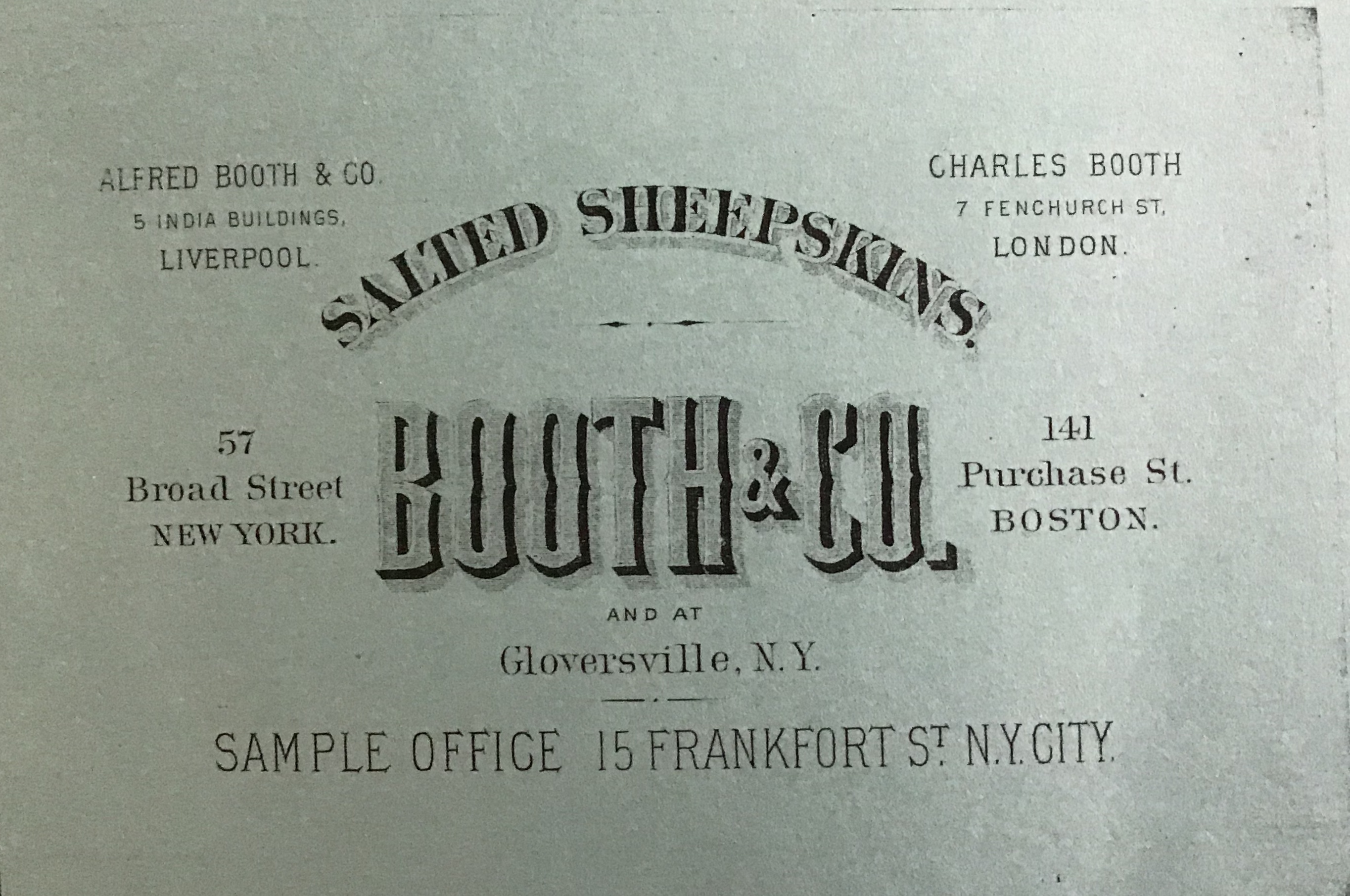
Charles Booth & Co, 7 Fenchurch St, London
Surpass Leather Co (1904 50% from 1908 100%)
Booth and Kent (from 1878 100%)
Kent and Booth
Booth and Kent and Company, Gloversville. “A large leather mill operation on Washburn and Grand Streets, across from Kent Street. (from Decker, 1998, Gloversville).
Manaos Harbour Company whose London offices moved into 11 Adelphi Terrace in 1888.
Booth and Co,( Inc,) 57 Broad Street, New York. 141 Purchase Street, Boston. Sample Office: 15 Frankfort St. New York City, and also at Gloversville, N.Y.
Booth & Co formed in 1901 to manage the tug and barge operations on the River Amazon
Melrose Tanners 100% purchased in 1948
The Pavlova Leather Company
The Boniface Sheepskin Company
Turney Brothers 100% from 1971
Charles Tanneries Set up in 1946 To sell Wades production and named Charles as key members of both Wade and Booth families called Charles
Nuneaton Wool Co?
Nuneaton Leather Co (Booth 50% Johnson 50%)
Wade and Co (50% Booth 50% Wade although at start up Booths had the majority. Booth bought 100% on the death of Charles Wade in 1956)
Atlantic Tanning
New Zealand Light Leather (10% Booth and 90% NZ fellmongers) later sold to Gomshall. Important source of crust for Pavlova from 1970
OFRO
Bulleys Tanneries Ltd (Thika & Kahawa factories)
Tombooth
Booth & Co (England)
Booth Overseas
Booth & Co (International)
Densten Felt & Hair Co, USA (bought around 1910)
Gardiner-Lucas Glue & Gelatine Corporation USA (bought around 1910)
B.Cannon & Co Ltd, Lincoln (acquired pre WWI, glue and gelatine; but there was some fellmongering or leather making done in Lincoln also, which was closed in 1917 when Alfred Booth bought into the Pavlova leather syndicate)
The Booth Steamship Co. Set up 1881 and reformed in 1901 on the purchase of Red Cross Iquitos Steamship.
The Unit Construction Company acquired 1919 form Crittalls
In 1964 after a family split the leather business was established separately as Booth and Company (International) Ltd. It became a public company in 1974 and was sold to Garnar-Scotblair in 1981. John Sebastian Macaulay Booth was the Managing
Director during this period. He was the grandson of Charles Booth who died on 23rd November 1916
Booth Mechanical services. Originally part of Alfred Booth Group. Continues to supply plumbing and heating services in the west of England, Based in Liverpool.Booth Men
Alfred Booth (founder) 1834-1914
Rt Hon Charles Booth (founder) 1840-1916
JSM Booth MD Booth International 1964-1980. 1913-1994
Charles Booth 1868-1938
Charles Wade Came from Grantham to the Nuneaton plant and then in 1901 bought Whitemoor Leather Works with Booth help to set up Wade and Co 1856-1924. Highly respected by Booths as a technician and tannery manager
Charles Booth Junior, eldest son of Alfred became partner in 1895 focused on shipping
Alfred Allen Booth (later Sir Alfred Booth, Bt.) younger brother of Charles Jnr joined company in 1895 focused on shipping
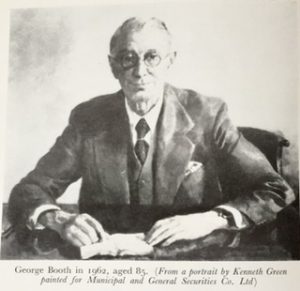
George Macaulay Booth second son of Charles, joined in 1895. focused on leather. Father of JSMB. The picture is taken from A man of push and go by Duncan Crow.
Dr Henry Booth Born 1901 son of Charles Booth jr (who became a director of Midland railway in 1898) Great Great nephew of Henry Booth (1789-1869) who was a partner with Stephenson in the development of the rocket steam engine. Chemist, worked in leather trade for 50 years in factories in Abingdon. Retired 1977 and wrote biography of Henry Booth on the steam engine.
David Allcock Technical, Wades & Holdens
Richard Amis CBE last Chairman of Alfred Booth & Co on whose watch the company was sold in 1986, Grandson of Sir Alfred Booth 1st Bart
John Barlow (Dr) original 60s/70s R&D, John went to the US with Rohm and Haas and then returned to Pittards in the UK
John Bartle Suede technician, Melrose
Charles Becker had charge of sales of shoe leather from both Gloversville and Philadelphia in 1894. Worked out of New York sorting office
Rowan Bell Kahawa Tannery manager circa 70s then went to NZ
Ron Bennett Director Pavlova, Wades from 1952 until 1971 then Pavlova. (Turneys before Wades) died December 2014
John Burstow Ulster Leather/ATCo
David Boyce (Accountant – Melrose, Pavlova, Kinswood)
David Bolle Pavlova Sales
Arthur Baxter (ran Booth & Co London Ltd with CJG in 1910
Horace Bradley, traffic manager of the Booth Line, retired 1945 after nearly forty-four years service in the New York office of the company. He joined the predecessor organization, Booth Co., steamship agents and leather merchants, on May 4, 1901, and remained through two reorganizations.
Dick Bigwither Supremo Booth & Co (England) Ltd
Paul Bloodworth Peripatetic Accountant – 1966-1994 Melrose Bulleys Holdens
ATCo/ULCo Turneys Scotblair Pittards Booth & Co(England) & partially Booth (Boston), Roorda BV
Tony Boucher Last Manager Booth & Co (England) Ltd. Died 2010 in Chichester
W.C.Burton Sailed with George Booth to US in 1917 to join the New York office (An American living in London as joint MD of JG White & Co which had set up the trams in Manáos and Para)
W.J. Cannon Cannons of Lincoln. W.J. Cannon was there in 1915 and advised George Booth on war supplies
Paul Chapman Finished at Pavlova
David Church Penultimate accountant Turneys.
Frank Critchley (Accountant/Secretary Wades 60s & 70s)
K Chapman Snr Booth (Boston) Ltd but started in Philadelphia in the 1940s
K Chapman Jnr Booth Boston plus Turneys. Only remaining company (2008) retaining the Booth name
A.N.Connett Sailed to US to join Booth New York with George in 1917. An American and with Burton was joint MD of J.G.White & Co.
Harold Connett Surpass Leather was Chairman of Tanners Council of America 1942
Paul Crompton Worked first for the Booths in China then ran USA and died with his family on the Lusitania
David Crompton USA. Became head of Booth interests in the US when C.W.Jones returned to Liverpool as a Director of Booth Steamship Company in 1910. Brother of Paul
John Coggins (Dr) Original Booths R&D
William Cunningham In 1890 joined Sydney Office. Cunningham moved to Gloversville in 1898 and later took over the pickled sheepskin department in New York.
Ken Delves Booth International Director, Managing Director Pavlova. Born in Southwell, Notts
David Donald (Group FD mid 60’s to 1981)
David (Mac) McDowell (Melrose & ET Holdens)
Dieter Demenco (Turneys for a spell 1978)
Joseph Dub (de Dubski) Slovakian – major player UCT Ltd
Kevin Feenan Sales manager ATCo & ULCo
Alec Finch Melrose MD, Director Booth International. then Pavlova; had job of closing many Booth and Garnar plants
Thomas Fletcher Partner, managed New York, started 1867. Died in 1904
Enfield Fletcher son of Thomas
Tom Fletcher son of Thomas
Alan Game Worked at Russells, Pavlova and at J&T Beavens at Holt. Died in 2010
Clement Gardiner Booth Man in US around 1917
CJ Garland One of the “Garland Brothers” in Liverpool 19th cent. Died 1904. Asone of the first employees Mr Garland looked after the office in India Buildings in Liverpool. Charles wrote “so we drop off one by one and what an old patriarch I become.”
Chris Glaysher Tombooth
AE Gaenslen (NY) opened Boston office and subsequently became partner in Alfred Booth and Co
Captain Good Booth Line master used as technical adviser for the Iquitos harbour works
Mike Green Booth & co (England) ltd
Robin Grossert Accountant/Secretary tombooth/bulleys
Jim Hillman Long time Pavlova accountant, before David Boyce
F.G. Heise Liverpool 1890s
Gustav Richard Heise Died 1896, worked with Alfred Booth and Co for 27 years.
Kurt Herschfeldt (original Atlantic Tanning boss)
Jack Husselby Long time Wades Gen. Mgr & Technical person (went to BLC on closure of Wades)
Jim Jackman Wade Technician who became head of Booths R&D after Mr Simon in 1968. Put a big effort into establishing the Leather Conservation Centre
C.W. Jones Sir Clement Jones. Hired by George Booth in July 1902 to help in the USA. Remained a great friend of Booths until he died 29th October 1963. “No choice could have been more fortunate for me in those first years in America when friction between factories and the young Englishman representing the absentee English owner would have been fatal”. Crow (p40)
James Kent Gloversville tanner invented Dongola tanning and the foundations of modern fatliquoring 1830-1885
Tadeus Kieniowicz Last Accountant Wade & Co
Julius Kuttner US manager who ran Kent tannery in Gloversville after Booths bought it and set up to develop Chrome Tanning. Died 1901
Bill (William) King (Bulleys technical – Canadian ex Kenya Hide Improvement commission)
Franklyn B. Kirkbride Appointed manager of American interests in August, 1905 (he was succeeded by Paul Crompton and Clement.W.Jones) All three made a strong team in the USA when George left in January 1906
Cyril Ladegourdie Chief Engineer Bulleys Tanneries
F.Lingebach (NY)
James J. Lyons February 12, 1890 – January 7, 1966 New York, American Democratic politician who served as Borough President of the Bronx (1934-1962). 1903 he worked as office boy in Surpass Leather and later as salesman. Quoted as saying he had sold enough leather to cover 4 million pairs of women’s feet.
Leo Macdonough (Group Accountant, then MD at Atlantic Tanning Co/ULC, then Pavlova)
Sir Peter Meinertzhagen Managing Director Alfred Booth and Co 1946-57
Ernie Mills Group Accountant & manager of Pavlova from 1969
FE Miller Australia 1890s. Frank Miller established the office close to the current Sydney Opera House
J.P.Mathieu Philadelphia tanner who worked with Booth to develop Surpass
AE Mould Liverpool 1890s
Len North One time Group Accountant?
Trevor Norris Technical Director Turney Bros in the 1970s
Paddy O’Flynn Formed OFRO. Quote JSMB “Our Fucking Rawstock Organisation”- Booth Overseas & Tombooth
Mike Parsons Pavlova, then ET Holdens – later BLC CEO and Scottish Group
Mr Poulter Snr Joined group from Pittards in 1948 and worked in Kenya. Bulleys having spent time in Wades, Pavlova and Melrose (which had just been bought). He worked there until the company split in 1962
Ron Poulter Jnr Studied at Leeds in 1961-65 with a grant from Booths and then worked at Pavlova 1965-1971, then Turneys until 1973 before leaving to join Eastern Counties, then Hodgsons in 1977. From 2006 in New Zealand.
Robert Parsons JSMB introduction – Cuero Garments ltd, Ex`Captain retired from the army
Pete Paterno American engineer at Turneys
Beatrice Potter Beatrice Potter (Webb) Cousin-in law of Charles and Mary Booth and worked with Charles on the “Book”. Very much influenced by her friendship with the family
Mike Redwood MD and Chairman Turneys 1977-1980. Also MD of Wades and Charles Tanneries
Mr Robilliard Booth manager in Manáos 1908
J Rotton Production, Pavlova Bulleys. Production Director Turneys. Grandson of GMB
John Rozemulder OFRO & Tombooth
George Rumpf appointed factory manager of Surpass in 1927 died 1951
John Rumpf father of George, and factory manager before him
Augustus Schultz Born in Germany …….Obtained his chrome patents in 1884 and then went on to work on inventions in central heating
Mr Simon Headed Booth R&D before Jim Jackman
Selby Smith New Zealand based Booth England
Bill (William) Stewart Director, Nottingham Tanneries Managing Director of Wades, Turneys and Charles Tanneries
Paul Stribbling Group Co Sec at time of “Going Public” and to 1979
Charles H.Skinner USA 1890s Factory manager of Surpass Philidelphia until retiring in 1927
Henry Shepard Chief engineer Pavlova 1969 to closure. Did a lot of group work
T.B.Southgate Brazil
Harold Tregoning Engineer in charge of harbour works in Iquitos, which Booths were constructing. A friend from Harrow of George so they had major reunion in 1908
Richard French Last accountant Booth Overseas?
Slavik Moucka (Chief Technician UCT/ULC)
Joe Jackson works engineer Pavlova
Ralph Liddyard Works Manager Pavlova
William Purcell Brazil 1890s
Benajamin Crimp Brazil
Charles Good Brazil
J.Clissold Brazil
Marcel Verwiel (Bulleys CEO, then Pavlova & Atlantic Tanning)
Max Wade (Charles Tanneries Sales – Original Wade family)
Weston Wade As Max Wade above.
John R Webb Liverpool 1890s
Marcel Werviel Took over Bulleys after Mr Poulter
Peter Wilcox Original Booths 60s/70s R&D
George S Wolff German origin Philadelphian who developed enamel finish to copy patent. Booth had JV with him, but not very successful
Yagnesh Kumar Zala [Babu!] (technician – Bulleys/R&D/Pavlova)
The first group of “Booth Men” were defined in the 1880s and 1890s when Charles moved to his system of less involved management.
Turney Brothers only
Sir Arthur William Black 28 February 1863 – 13 July 1947[1] was an English lace manufacturer from Nottingham and a Liberal Party politician who served in local government in Nottingham before holding a seat in the House of Commonsfrom 1906 to 1918. He was a director of Turney Brothers
Charles J. Pain, F.C.A. Vice-Chairman in 1927
Sir Arthur W. Black director 1927
John A. E. Turney director 1927
Douglas J. Law director 1927